


Copper prices are climbing at a rate that is forcing global markets to rethink the future of industrial raw materials. What once largely moved in tandem with demand from the construction sector and manufacturing cycles is now being reshaped by artificial intelligence, geopolitical conflicts, electrification, and deep structural deficiencies.
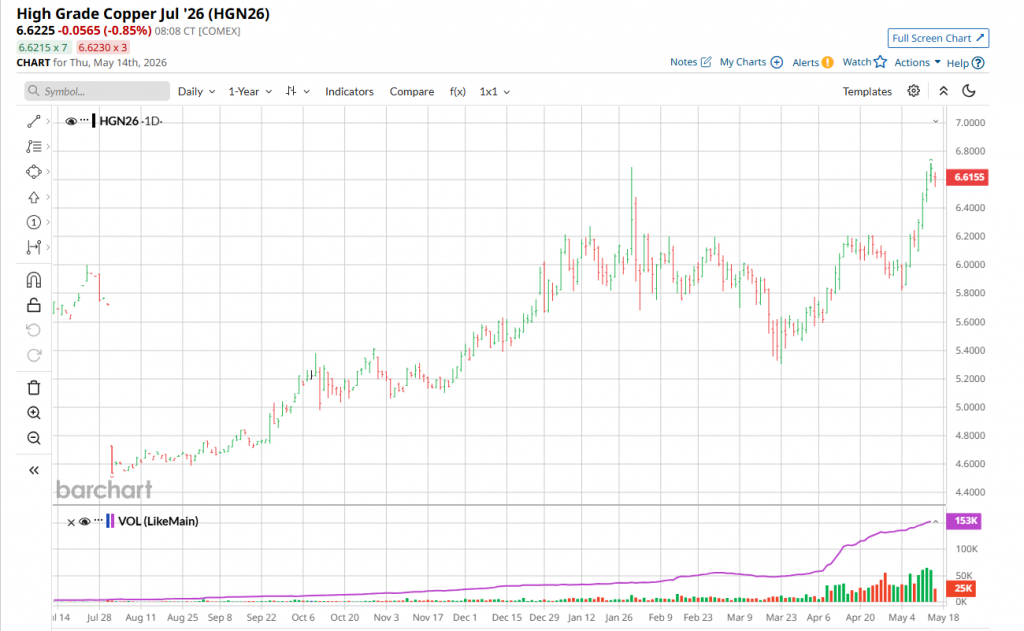
This week, copper prices on the London Metal Exchange (LME) soared above $14,000 per tonne, while copper futures on COMEX topped $6.50 per pound, thus extending one of the most vigorous commodity rallies in recent years.
The speed of this movement has captured investors’ attention. Since tensions escalated around Iran and the Strait of Hormuz, copper prices have already rebounded by nearly 8%, while year-to-date gains are approaching 15%. However, traders increasingly believe that this rally is not just another temporary surge in the commodities market. On the contrary, markets are beginning to price in a global scenario in which copper emerges as one of the most strategically important materials in the age of artificial intelligence.
The United States Copper Index Fund (CPER) hit a new all-time high of $40.46 on Tuesday, representing a 15.7% increase since January and nearly 10% in the last month alone.
Currently, copper futures have risen approximately 75% since October 2023; a surge that tells a story far more significant than that of a simple metal, revealing the clash between a new technological era and decades of insufficient investment in the geological resources that lie beneath our feet. What is driving copper prices higher today is not an isolated event or a specific headline, but rather the convergence of a series of structural forces that, once understood, completely transform our perception of the global economy.
Why Copper Futures Are Soaring Towards Record Highs in 2026
The surge in copper futures recorded in 2026 has its roots in a crisis that most investors initially viewed for entirely different reasons. When the conflict involving Iran erupted, the Strait of Hormuz — one of the world’s most critical maritime chokepoints — was effectively closed to the shipping of sulfuric acid. This detail might seem insignificant, but it is the fundamental reason why copper prices are currently at record levels.
Sulfuric acid is an essential auxiliary material in the copper smelting process, specifically used in heap leaching to extract the metal from the raw ore. Nearly half of the world’s seaborne sulfuric acid supply comes from the Middle East, where sulfur — a byproduct of petroleum refining — is produced in abundance by Iran, Saudi Arabia, and the United Arab Emirates.
When disruptions to shipping through the Strait of Hormuz proved far more prolonged than markets had anticipated, the global sulfuric acid supply chain fractured. Its highly corrosive nature makes land-based transport alternatives impractical on a large scale. The gap between supply and demand widened rapidly.
Sulfur prices surpassed the $1,200 per metric ton mark, a record high confirmed in Mosaic’s latest quarterly report.
China, already facing its own internal supply pressures, tightened restrictions on sulfuric acid exports starting in May, further intensifying the shortage.
Chilean copper producers, whose output had already fallen by about 6% in the first quarter of 2026 compared to the previous year, felt the full weight of the shortage even before its impact had been fully reflected in market prices.
Copper futures contracts reacted urgently, and rightly so. Edward Meir, an analyst at Marex, noted that the duration of the transit restrictions in the Strait of Hormuz exceeded what the market had projected in its models, forcing traders to recalculate both the short-term supply risk and long-term capacity forecasts for one of the world’s most essential industrial metals.
The Rise of AI Infrastructure Is Redefining the Demand for Copper Forever
This is where the story of copper futures becomes more than just a speculative trade based on a supply disruption. The demand side of this equation has been quietly transforming over the past two years, and artificial intelligence is the engine driving this change.
High-purity copper forms the connective tissue of AI computing infrastructure. It runs through the power supply modules and signal transmission systems within AI servers. It shapes the high-speed interconnect cables that link tens of thousands of processors within hyperscale data centers. It is found inside the liquid cooling systems that prevent these processors from melting under the thermal loads generated by training large language models.
In the short term, there is no substitute material that matches copper’s combination of electrical conductivity, thermal performance, and large-scale manufacturing capabilities. A single large-scale data center can consume thousands of tons of copper. The most ambitious supercomputing facilities require over 10,000 tons of copper alone.
As global technology companies race to build the infrastructure that will support the next generation of AI workloads, the pace of data center construction has accelerated dramatically. Microsoft, Google, Amazon, and Meta have collectively announced hundreds of billions of dollars in capital expenditures for AI infrastructure.
Each new installation secures years of copper demand. ING analysts noted that the price correlation between copper and US technology stocks has strengthened considerably, reflecting the growing market understanding that copper is becoming, in a significant sense, a critical raw material for artificial intelligence (AI).
Copper futures are not only reacting to geopolitics; they are incorporating into their prices a structural demand regime unlike any other the copper market has previously faced.
The Delay at Grasberg and the Mining Supply Wall That Copper Cannot Climb
Even without the sulfuric acid crisis, copper futures faced a formidable supply problem in 2026. The Grasberg copper mine in Indonesia — the world’s second largest by production volume — has been operating below full capacity following a landslide in September.
Freeport-McMoRan’s subsidiary confirmed that the full restart of operations has been postponed until early 2028 due to additional infrastructure requirements. The company revised its 2026 targets, setting them at just 65% of capacity during the second half of the year, before increasing to 80% by mid-2027. Although Freeport-McMoRan later reiterated its official forecast of a restart by the end of 2027, the market interpreted the news as confirmation of what it already suspected: bringing new copper supply sources online is a slower, more difficult, and more expensive process than the current demand curve demands.
Jacob White of Sprott Asset Management clearly explained the structural constraint: the copper industry was already grappling with declining ore grades, meaning copper content, before the current crisis. Lower copper content per ton of ore means that more rock needs to be moved, more energy consumed, and more capital mobilized to produce the same pound of refined copper.
If we add to this the reality of long mine development cycles, increasingly complex permitting processes, and the geographical concentration of known copper deposits, the supply side of the copper futures equation appears destined to remain restricted for years, not just months.
Orest Wowkodaw, a mining analyst at Scotiabank, drastically revised his outlook for the copper market in recent weeks, projecting a global supply deficit of 350,000 tons by 2027; a radical change from the expectation of near-total equilibrium that was maintained just two months ago.
“This truly constitutes a ‘perfect storm’ for copper prices,” said Wowkodaw, adding that the current strength of global copper demand is unprecedented and provides a firm foundation for a sustainedly higher price environment.
What the Options Market and “Smart Money” Say About Copper Prices
When professional capital shifts its position in the derivatives market, it’s usually because it has inside information. Bart Melek, Director of Global Commodity Strategy at TD Securities, highlighted a surge in options activity, with a substantial flow of capital into derivatives that benefit from the rising price of copper. Investors aren’t simply reacting to the current supply shock; they’re positioning themselves for a multi-year structural deficit.
The CPER ETF, which tracks COMEX copper futures, has become the preferred vehicle for investors seeking exposure to copper prices without having to directly manage futures contracts.
With $735.9 million in assets under management and an average daily volume of 727,000 shares, the recent surge in the CPER to record highs reflects both institutional conviction and the growing awareness of retail investors regarding the copper situation.
Billionaire investor Robert Friedland has publicly warned about the domino effect that the disruption in the Strait of Hormuz is causing in critical industrial supply chains, thus lending greater credibility to the thesis that copper prices are not immersed in a temporary speculative bubble, but rather respond to genuine and lasting imbalances.
Chinese export data added a new dimension to the demand picture. Chinese exports surged 14% year-on-year in April, driven in part by shipments of clean technologies and industrial components with high copper content. The rebound in Chinese manufacturing activity — with the PMI reaching a five-year high — has fueled a recovery in physical copper demand, even as the global economy grapples with high interest rates and uncertainty in stock markets.
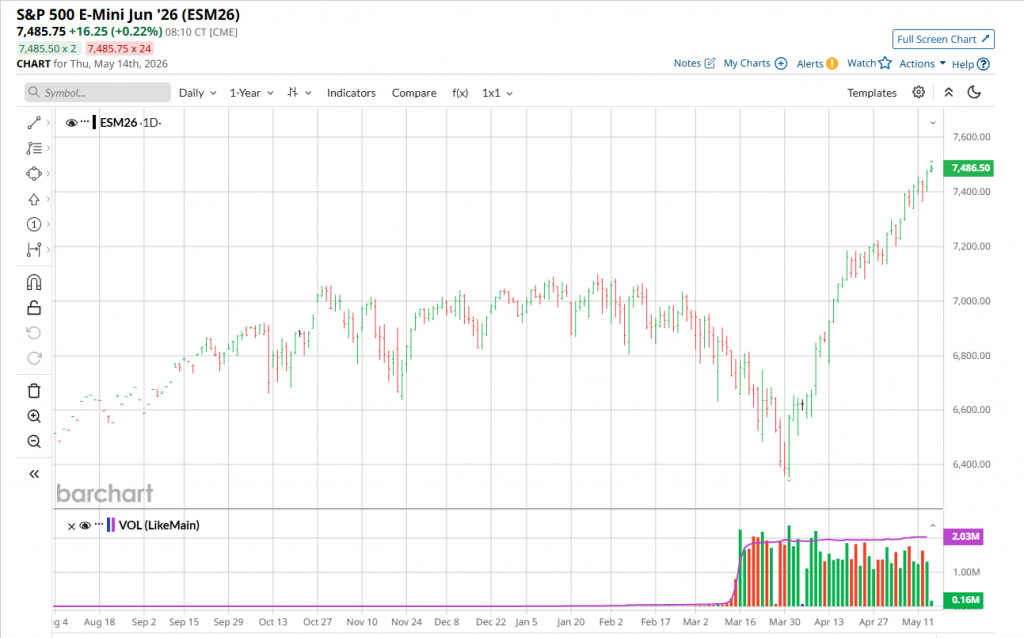
The S&P 500 fell 0.43% on Wednesday; the Dow lost 0.55%, and the NASDAQ declined 0.66%. Copper, on the other hand, posted gains. This divergence is a signal that warrants closer analysis.
Ewa Manthey, ING’s commodity strategist, noted that outside the US, copper inventories in other regions are at low levels, making the metal’s price extremely sensitive to any further shocks to demand. When inventories are tight, the buffer against surprises disappears. Every data center contract, every uptick in manufacturing activity, and every delay in a mine reopening influences the price in real time. What’s unfolding in the copper futures market is the physical economy catching up with the promises that technology companies have made to their shareholders and users. The AI revolution requires electrons, and electrons require copper.