

Increasing size based on recent wins is a psychological trap known as “recency bias” or “gambler’s fallacy in reverse,” where a trader feels invincible. In futures trading like the Micro E-mini Nasdaq-100 (MNQ), scaling up must always be a systematic, rule-based decision rather than an emotional reaction to short-term outcomes.
Why This Approach Is Dangerous
- Distorts Risk Management: Moving from a single lot to two contracts instantly doubles the dollar risk per trade. If your average stop loss is 30 points, a loss on a single contract costs $60; on two contracts, it immediately jumps to $120.
- Wipes Out Gains Faster: A single loss at double the size will completely erase two wins achieved at the smaller size, assuming equal risk-to-reward ratios.
- Sample Size Illusion: Two days of trading represent a statistically insignificant sample size. A winning streak can easily be the result of a temporary market regime that perfectly favors your current chart settings, rather than a permanent increase in skill.
- Introduces Psychological Tilt: Trading larger sizes alters a trader’s relationship with risk. The larger fluctuating dollar amounts frequently cause traders to hesitate, move stop losses prematurely, or cut winners short out of fear.
The Correct Way to Scale Up Position Sizes
Instead of sizing up based on feelings or a brief streak, you should follow a structural staging framework:
- Enforce a Milestone Progression: Require a larger statistical sample size before touching leverage. For example, you must maintain profitability over a minimum of 20 to 30 trading sessions or a full calendar month.
- Build a Profit Ballast: Establish a mathematical “buffer” in the account. You should only trade two contracts if the account has grown enough to comfortably absorb a maximum drawdown at the new, higher risk level without breaching account equity rules.
- Step Up Incrementally: If you ultimately meet your performance milestones and profit buffers, you can transition smoothly by executing the larger size on only your highest-probability, A+ setups first, rather than instantly doubling your size across every single trade.
An example with $1,000 in your trading account
An account equity of $1,000 with a strict “one-and-done” daily loss limit means doubling to 2 contracts immediately is highly unsuitable and risks blowing the account.
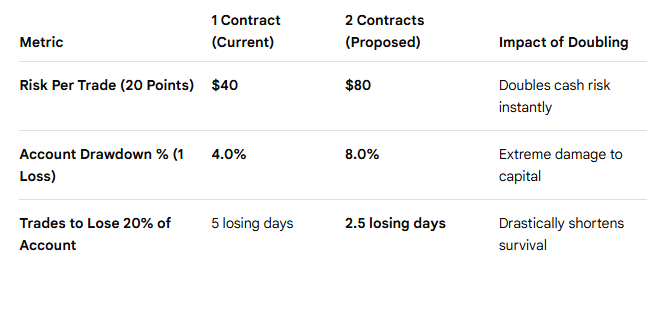
With a 20-point risk per trade on the Micro E-mini Nasdaq-100 (MNQ), each point is worth $2.
Risk Breakdown: 1 Contract vs. 2 Contracts
Why the Math Does Not Work For 2 Contracts
- Violates the 2% Rule: Professional risk management dictates risking no more than 1% to 2% of total account equity on a single trade. At 1 contract, you are already aggressively risking 4% of the account per trade. Moving to 2 contracts pushes that risk to 8%, which is dangerously over-leveraged for a $1,000 account.
- Margin Call Vulnerability: While intraday maintenance margin requirements vary by broker, a $1,000 balance leaves very little breathing room. A string of just three or four consecutive losing days at 2 contracts would shrink the account equity down to $680–$760, potentially triggering automatic liquidation by the broker due to insufficient intraday margin.
- The “One Loss” Psychological Trap: Because your maximum daily loss limit is exactly 1 trade, a single loss at 2 contracts locks in an $80 deficit for the day. Watching 8% of the account disappear in minutes makes it incredibly difficult to follow the rule and walk away, heavily increasing the risk of emotional “revenge trading.”
Recommended Milestone Checklist to Size Up
Before you scale up to 2 contracts, you should mathematically earn the right to do so by hitting these specific targets:
-
- Grow Equity to $2,000: This establishes a 100% capital buffer. At $2,000, an $80 risk per trade drops back down to a more manageable 4% account risk.
- Maintain 20 Active Trading Days: You must prove you can protect the $1,000 account over a continuous 3-to-4-week period using just 1 contract, showing behavioral consistency through both winning and losing market cycles.